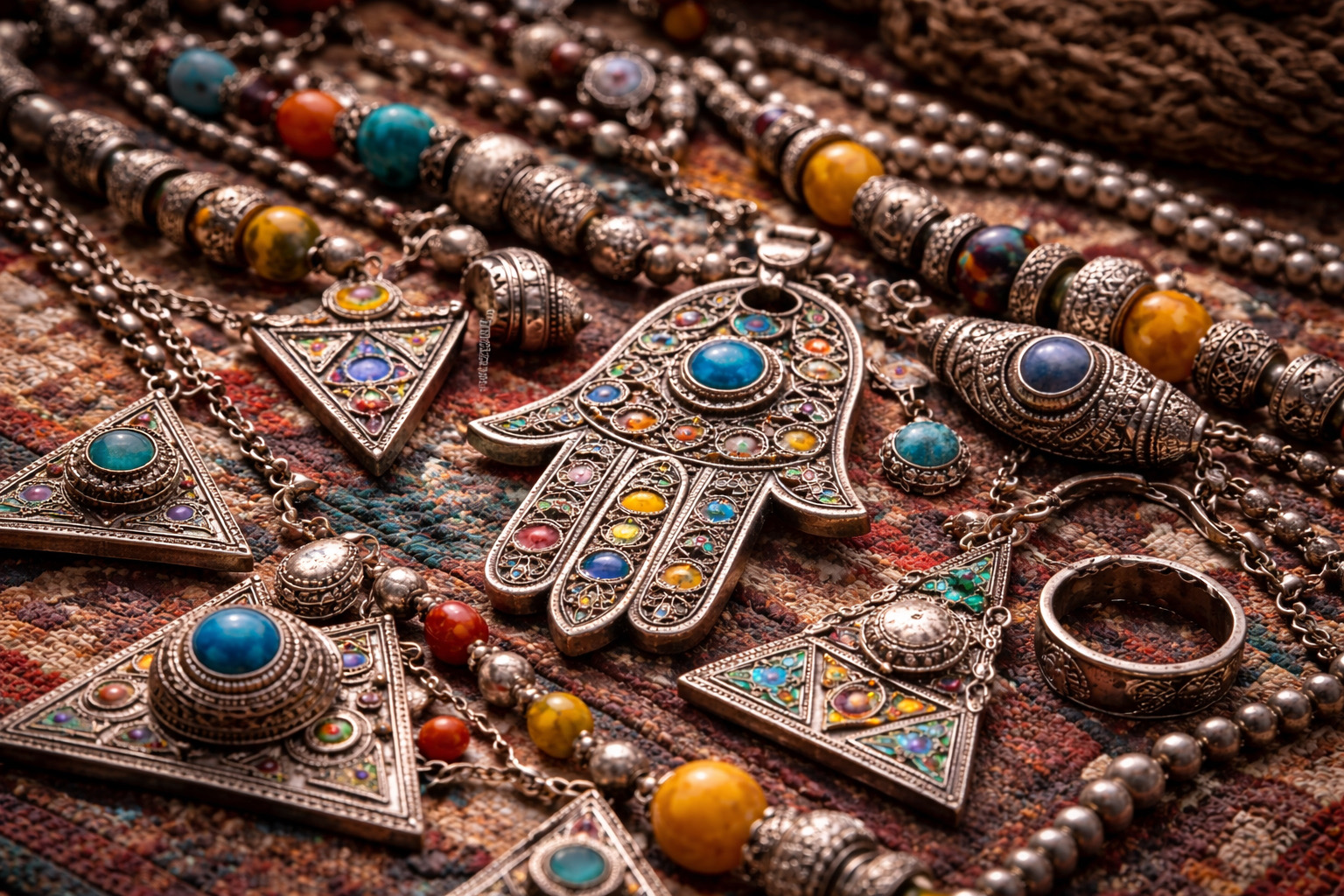
Why Moroccan Jewelry Is Full of Protective Symbols
If you’ve ever held a piece of Moroccan jewelry, you might have thought that it was doing more than just making you look good.
Hands, triangles, eyes, bright enamel colors, and engraved shapes are some of the things that keep showing up. Not as trends. Not by chance.
They are there because Moroccan jewelry was never meant to be plain.
For hundreds of years, jewelry in Morocco was like a portable shield. People wore it every day, carried it long distances, passed it down through generations, and trusted it to protect them from harm they couldn’t see.
Fashion isn’t the best place to start when trying to understand Moroccan jewelry.
You start with belief.
Jewelry as Protection, Not Ornament
In many Moroccan traditions, especially Amazigh (Berber) ones, jewelry served a role closer to a talisman than an accessory.
Historically, jewelry was worn to protect against
- Illness
- Misfortune
- Envy and the “evil eye”
- Vulnerability during travel, pregnancy, or transition
This is why jewelry wasn’t reserved for ceremonies alone. It was worn daily, often layered, sometimes heavy, always intentional.
A bracelet wasn’t chosen because it matched an outfit.
It was chosen because it meant something.
Why Protection Is So Central in Moroccan Culture
Protection appears everywhere in Moroccan material culture—not just jewelry.
You see it in:
- Architectural symbols
- Textile motifs
- Amulets
- Body adornment
This comes from a worldview where life was unpredictable and security fragile. Jewelry became a way to carry reassurance with you—to create a small sense of control in an uncertain world.
Importantly, this protection wasn’t abstract or mystical in the modern sense. It was practical belief, woven into everyday life.
Jewelry didn’t promise perfection.
It promised balance.
Common Protective Symbols You’ll See Again and Again
Moroccan jewelry doesn’t use symbols randomly. Many repeat across regions because they speak a shared visual language.
The Hand (Khamsa)
Often misunderstood as decorative, the hand symbol is one of the most powerful protective forms.
It represents:
- Protection against the evil eye
- The idea of stopping harm before it reaches the body
- Balance between giving and receiving
It’s usually worn outward-facing, acting like a visual shield.
Triangles and Diamond Shapes
Triangles appear constantly in Moroccan jewelry and textiles.
They’re often linked to:
- Femininity
- Fertility
- Stability
- Protection during life transitions
When repeated or layered, they reinforce protection rather than dilute it.
Eyes and Eye-Like Motifs
Whether literal or abstract, eye motifs are meant to deflect harmful gazes.
They don’t invite attention—they redirect it.
This is why you’ll often see asymmetry or bold contrast around these shapes. The goal isn’t harmony. It’s interruption.
Why Enamel and Bold Color Matter
Color in Moroccan jewelry is not subtle—and that’s intentional.
Bright enamel blues, greens, yellows, and reds were believed to:
- Distract harmful attention
- Strengthen symbolic power
- Signal vitality and presence
Silver was also preferred over gold in many regions—not for status, but for its perceived protective qualities and accessibility.
Nothing here is accidental. Even “excess” has purpose.
Jewelry as Identity and Memory
Moroccan jewelry also functioned as:
- Personal savings
- Family inheritance
- Markers of region or marital status
A woman’s jewelry could tell you:
- Where she came from
- Whether she was married
- What stage of life she was in
Symbols weren’t chosen freely. They were learned, repeated, and respected.
This is why treating Moroccan jewelry as purely decorative strips it of its original voice.
Why Modern Listings Often Miss the Point
Many modern explanations reduce Moroccan jewelry to:
- “Bohemian”
- “Ethnic”
- “Tribal-inspired”
These labels flatten meaning into style.
When symbols are presented without context, they become empty shapes. Beautiful—but disconnected.
Understanding doesn’t require memorizing definitions.
It requires recognizing intention.
Wearing Moroccan Jewelry Today—With Awareness
You don’t need to share the same beliefs to respect the symbols.
What matters is:
- Knowing the jewelry wasn’t created as a neutral object
- Understanding that protection—not fashion—was the starting point
- Wearing it with curiosity rather than assumption
Moroccan jewelry doesn’t demand belief.
It invites acknowledgment.
Why This Still Matters
In a world of fast fashion and trend cycles, Moroccan jewelry reminds us of something quieter and older:
Adornment can be meaningful.
Beauty can carry responsibility.
Objects can hold care.
When you wear Moroccan jewelry, you’re not just wearing silver or enamel.
You’re wearing a language—one shaped by protection, memory, and lived experience.