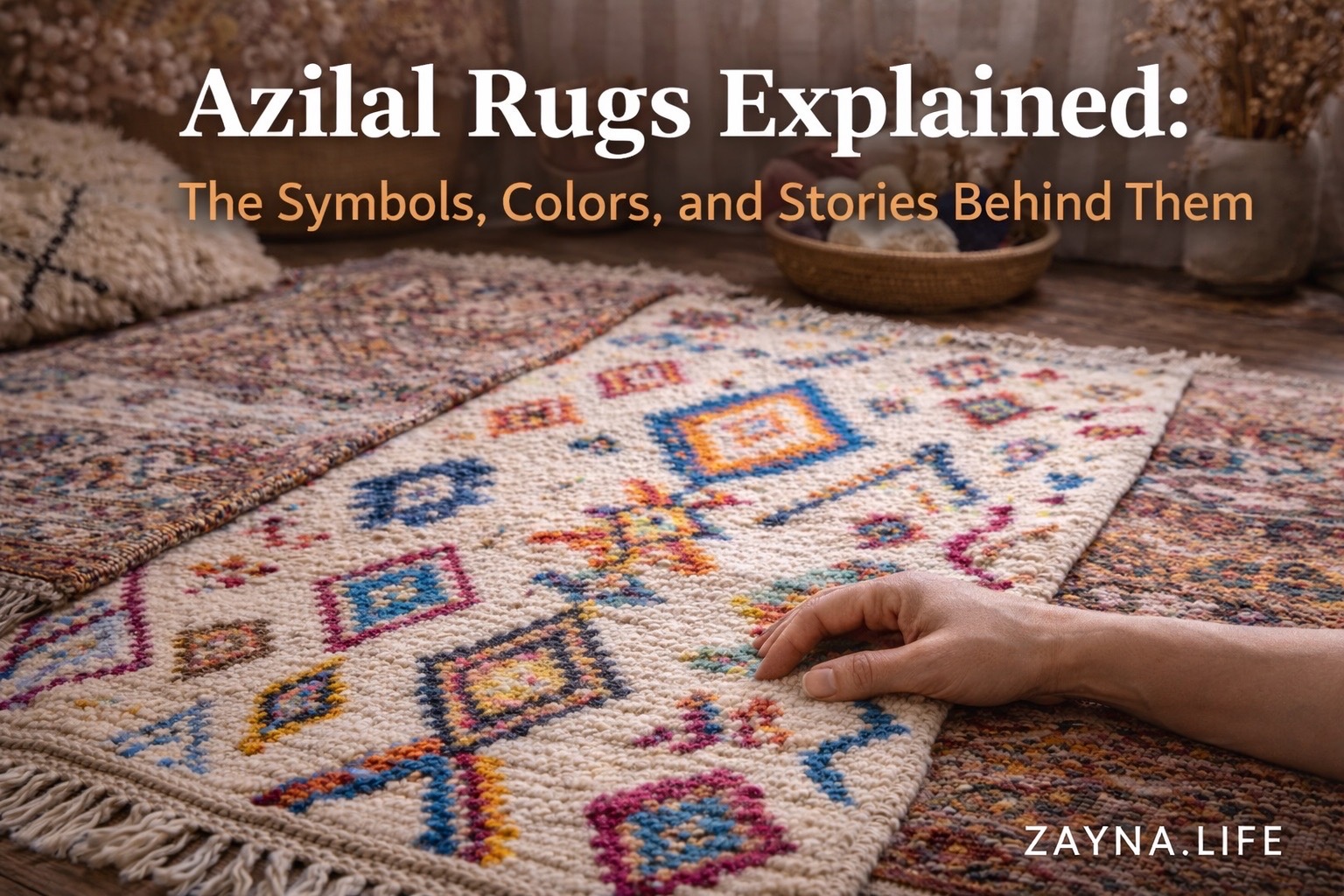
Azilal Rugs Explained: The Symbols, Colors, and Stories Behind Them
Azilal rugs often stop people in their tracks.
It’s not because they’re “perfect,” or even conventionally beautiful, but rather because they evoke a sense of life. Lines wander. Colors clash or sing. Symbols appear without explanation. And somehow, it all works.
Online, Azilal rugs are usually described as playful, abstract, or bohemian. Those words aren’t wrong, but they’re incomplete. They focus on how the rug looks, not on why it looks the way it does.
Azilal rugs are not designed to fit a style.
They are woven to express something personal.
To understand them, you must step away from design trends and closer to the lives of the women who make them.
Where Azilal Rugs Come From
Azilal rugs originate in the High Atlas Mountains of Morocco, particularly in the Azilal province. This province is a rugged, rural region where weaving has long been part of daily life, not commerce.
Historically, Azilal rugs were woven for:
- Warmth during cold mountain winters.
- Use it inside the home.
- Personal or family milestones.
They were not made to be sold.
They were made to be lived with.
This concept matters because it explains why Azilal rugs don’t follow strict rules. There was no market expectation, no standard size, and no fixed palette. Each rug was shaped by the weaver’s materials, time, mood, and story.
Why Azilal Rugs Look So Different from Other Moroccan Rugs
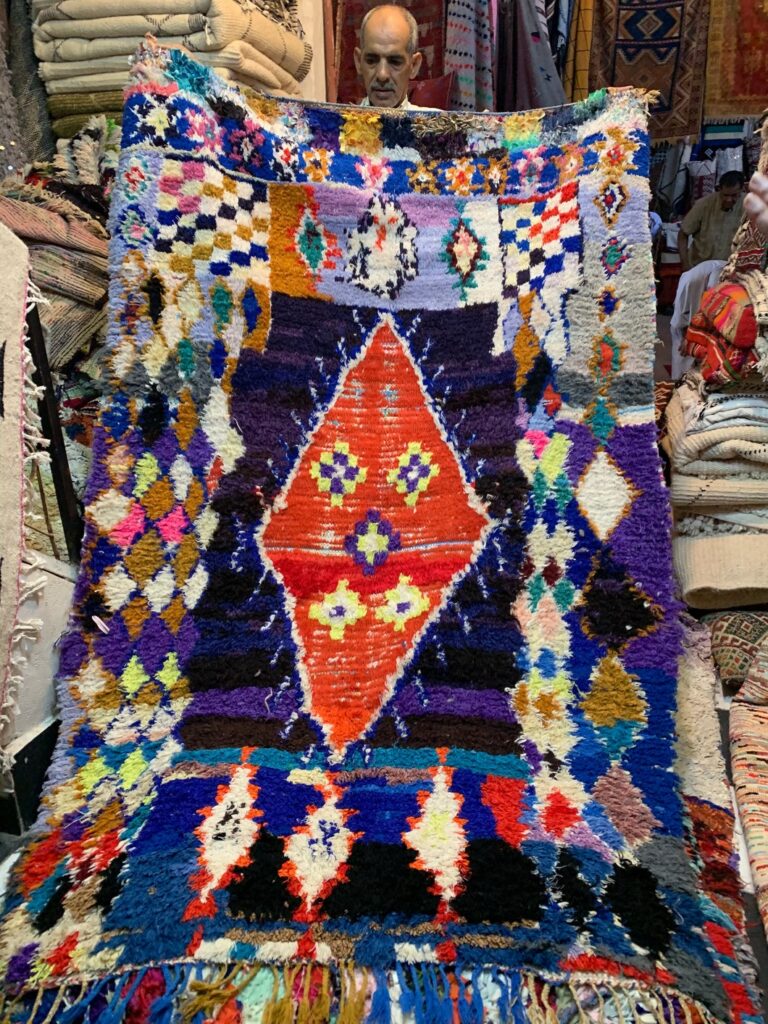
If you’re familiar with Moroccan rugs, you might notice that Azilal rugs don’t behave like Boujad, Beni Ourain, or Beni Mrirt rugs.
That’s intentional.
Azilal rugs are typically:
- Lighter in weight and less dense.
- Woven with wool mixed with cotton.
- The design is more graphic and spontaneous than traditional weaving methods.
Where some traditions emphasize consistency or durability, Azilal weaving prioritizes expression.
Think of them less as functional floor coverings and more as woven drawings.
Symbols in Azilal Rugs: Meaning Without a Dictionary
One of the most common questions that buyers ask is, “What does this symbol mean?”
The honest answer is, it depends.
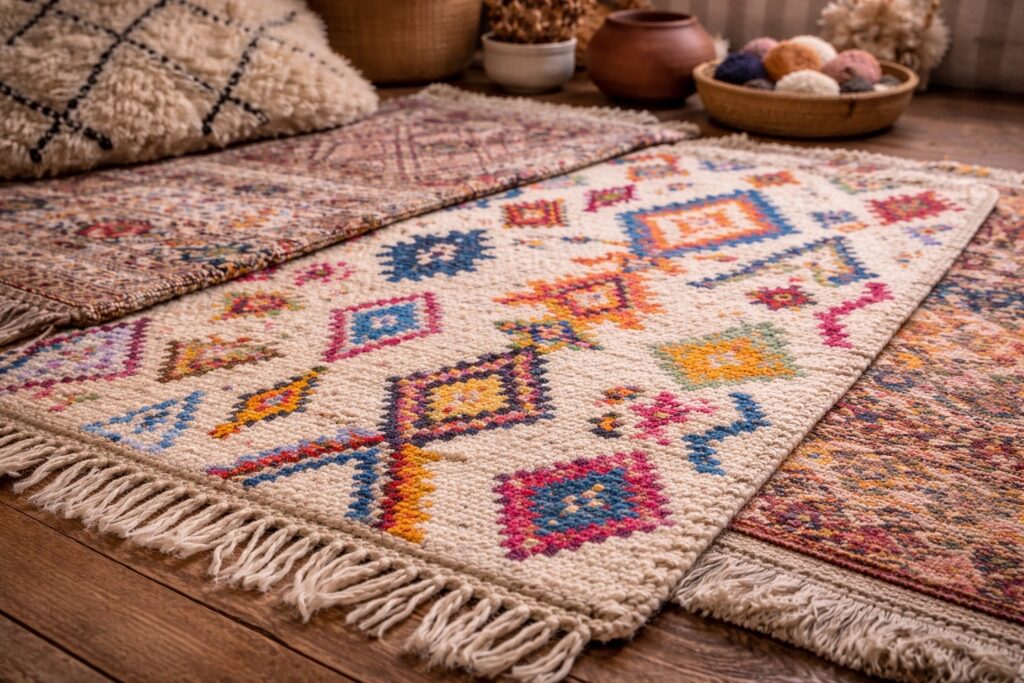
Azilal symbols lack standardization, unlike more codified weaving traditions. A diamond, a line, or a figure doesn’t carry one universal meaning across all rugs.
Instead, symbols often relate to:
- Personal experiences.
- Emotional states.
- Memories or desires.
- Protection, fertility, or movement.
A shape might reference a pregnancy, a journey, a loss, or simply a feeling the weaver wanted to capture that day.
This is why attempting to “decode” an Azilal rug as if it were a language often fails to capture its essence. These rugs aren’t messages meant to be translated word-for-word. They’re expressions, closer to poetry than text.
Color Choices: Emotion Over Harmony
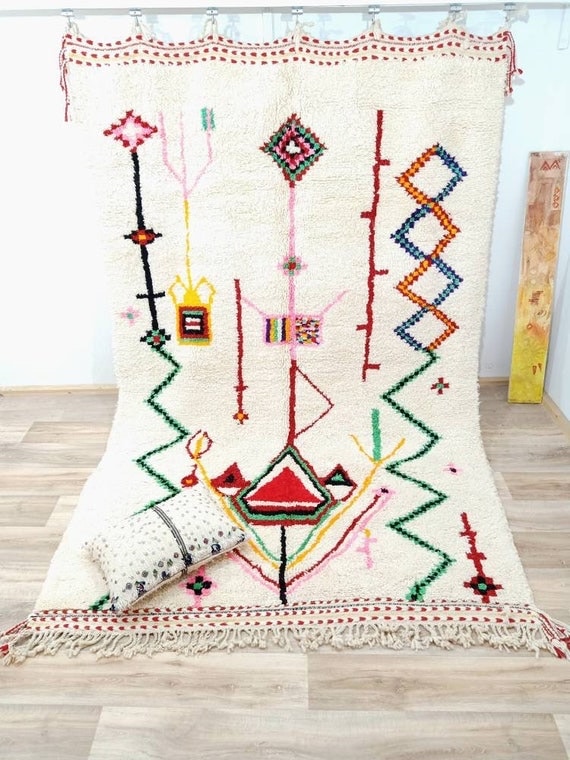
Azilal rugs are renowned for their bold color combinations, sometimes joyous, sometimes jarring.
This isn’t accidental.
In traditional Azilal weaving:
- Colors were chosen based on available dyes.
- Emotional resonance mattered more than balance.
- Contrast was welcomed and embraced.
You might see:
- Bright reds are juxtaposed with soft neutrals.
- You might notice sudden bursts of yellow or blue.
- The design features both empty spaces and dense color.
From a modern design perspective, this can feel risky. From a cultural perspective, it’s honest.
The rug doesn’t exist to soothe a room.
It exists to say something.
No two Azilal rugs are alike.
Even within the same village, two Azilal rugs can feel radically different.
That’s because:
- Designs aren’t copied from patterns
- The weaving decisions are made in real time.
- The rug evolves as it’s woven.
If a weaver changes her mind halfway through, the rug changes too.
This is why Azilal rugs often feel more human than polished. You can sense pauses, shifts, and decisions woven into the surface.
Common Buyer Mistakes with Azilal Rugs
Because Azilal rugs are so visually striking, buyers often approach them the wrong way.
Some common missteps:
- Expecting every symbol to have a fixed meaning
- Choose based only on color without considering scale.
- People often confuse Azilal rugs with Boujad or Boucherouite styles.
- This includes purchasing “Azilal-style” rugs that are made for export and lack spontaneity.
A real Azilal rug may feel imperfect. That’s not a flaw; it’s the point.
Who Should (and Shouldn’t) Buy Azilal Rugs
Azilal rugs resonate deeply with people who:
- Value story over symmetry.
- See rugs as art objects, not just decor.
- Enjoy visual tension and emotional texture.
They may feel challenging for those who prefer:
- Strict balance.
- Minimal, neutral environments.
- Rugs that quietly blend into the background are preferred.
Neither preference is better.
But Azilal rugs don’t apologize for being expressive.
How to Live With an Azilal Rug
Azilal rugs often work best when you:
- Give them a visual space.
- let them lead the room, not compete with it
- Treat them as focal points.
They’re especially compelling in:
- Creative spaces.
- Eclectic or art-driven interiors.
- These are spaces designed to foster conversation rather than tranquility.
Seeing Azilal Rugs for What They Are
An Azilal rug isn’t asking to be decoded, matched, or justified.
It’s asking to be seen.
Seen as the product of a moment, a place, and a person. Seen not as “imperfect,” but as intentionally human.
Once you stop asking what an Azilal rug means and start asking what it feels like, you’re much closer to understanding it.